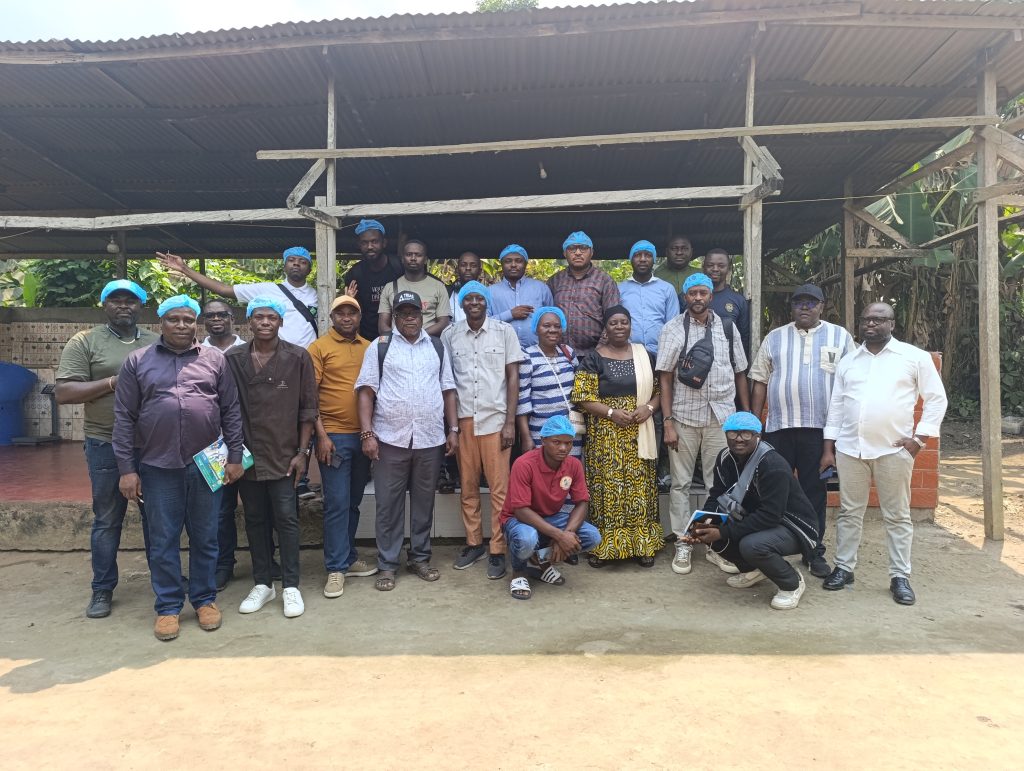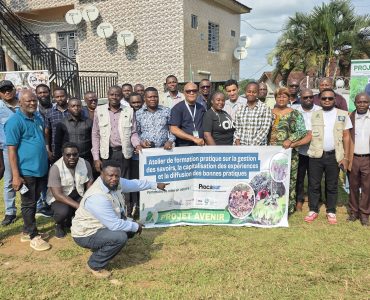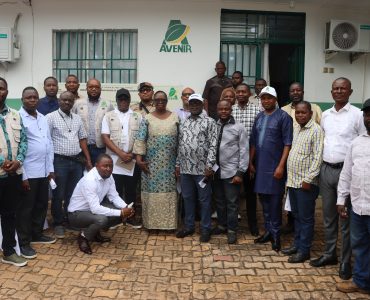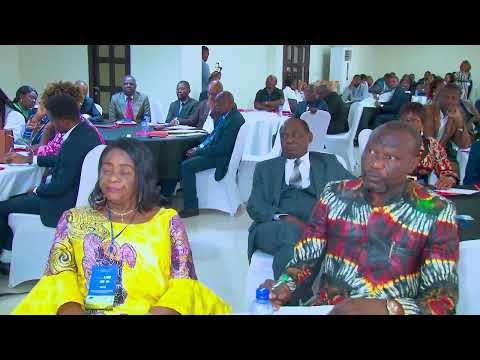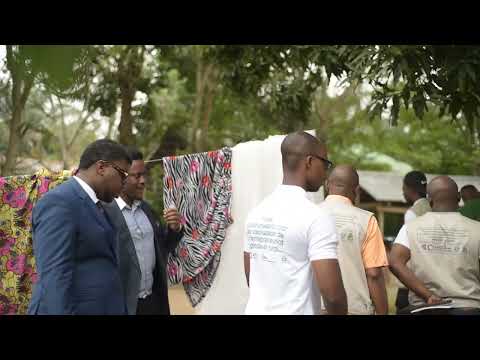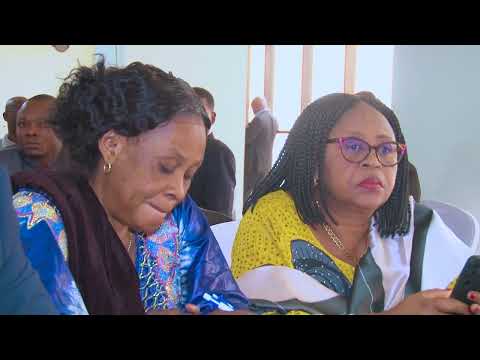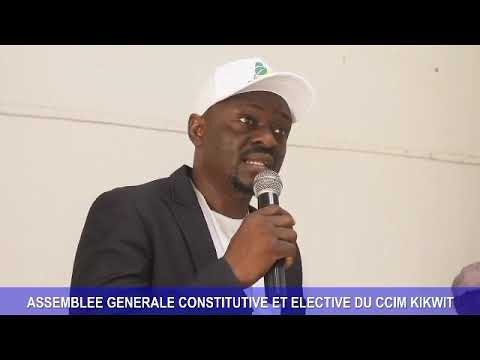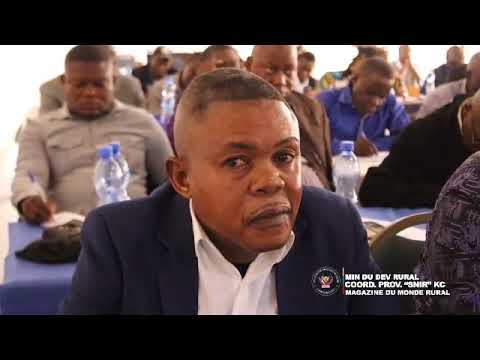
Kikwit hosted the 2025 evaluation and 2026 planning workshop for the AVENIR Project with the provincial federations and RENAFER
Dialogue national sur les droits des Peuples Autochtones Pygmées : ouverture officielle des travaux à Kinshasa
Revue annuelle du Portefeuille FIDA – 2025 : des résultats probants au service du développement rural
Kikwit hosted the 2025 evaluation and 2026 planning workshop for the AVENIR Project with the provincial federations and RENAFER
Lancement de l’atelier de présentation et validation du PTBA 2026 du projet AVENIR à Venus Village, N’sele
Signing of a Memorandum of Understanding between the AVENIR Project and the GUILGAL Microfinance Company: A decisive step towards the financial inclusion of young and women agricultural entrepreneurs
DRC: Reforming Congolese agriculture, a strategic priority at the heart of Minister of State Muhindo Nzangi Butondo's vision
National dialogue on public policies on agricultural entrepreneurship in the DRC: the AVENIR Project at the heart of discussions for a competitive and sustainable private sector
The AVENIR Project Highlights Traditional and Local Foods at FESTAL 2025
Word from the Project Director

Placed under the supervision of the Ministry of Agriculture and Food Security of the Democratic Republic of Congo, the Empowerment Project through,Nutrition-sensitive, Inclusive and Resilient Agricultural and Rural Entrepreneurship project (AVENIR) is funded by the French Development Agency (AFD), the International Fund for Agricultural Development (IFAD), the Global Environment Facility (GEF) and co-financed by the Congolese government to the tune of USD 213.5 million. The project is implemented over a period of 7 years (August 2023-August 2030) in the four provinces surrounding Kinshasa(Kongo Central,, Kwango,, Kwilu, Maï-Ndombe) and the outskirts of Kinshasa 

As Project Director, I am honored to highlight the importance and necessity of promoting family farming accompanied by agricultural and rural entrepreneurship of young people and women to expect a significant increase in household income in the project area. This is even more impactful when we focus on opening up rural areas through the rehabilitation of access roads to agricultural production areas and the construction of agricultural product markets to boost the local economy by attracting urban financial resources.
As part of the implementation of its activities, the AVENIR Project mainly targets women and young people (aged 18 to 35) but also populations living with disabilities (PLWH) and indigenous pygmy peoples (IPPs), qu’ils aient déjà investi ou non dans les activités agropastorales. Il s’adresse à ceux qui portent des projets individuels ou collectifs de création d’entreprises ou de développement dans les secteurs agro-sylvo- agricoles.
Nos efforts conjoints visent d’une part, à renforcer les capacités des familles agricoles, à promouvoir des pratiques agricoles durables et à encourager l’entrepreneuriat rural ; d’autre part, à améliorer les régimes alimentaires des ménages ainsi que de faciliter l’accès à l’eau potable pour lutter contre la malnutrition chez les enfants de moins de 5 ans dans notre communauté. Ensemble, nous pouvons transformer les défis en opportunités et bâtir un avenir prospère pour nos communautés rurales.
The AVENIR Project mainly encourages young people and women, PLWH, IPPs and all other stakeholders to take ownership of the project activities. Also, to use this platform (website) set up which is a tool for communication, sharing of documentation and knowledge management for all stakeholders.
This project is part of the achievement of the vision of the DRC’s President, His Excellency Félix Antoine Tshisekedi Tshilombo, I quote: “It is time for the soil to take its revenge on the subsoil”..
Our gratitude to the Congolese government, which through its commitment, wants to make agriculture one of the main pillars of economic growth for local communities. 
Our gratitude also goes to all our donors, our implementing partners, farmers' organizations, and local communities for their commitment and unwavering support for this project. We are continuing to work together hand in hand to achieve our common goals and make our project a real locomotive for development in rural areas.
Together, let's build the future of the agricultural sector by promoting entrepreneurship in rural areas!
Justinien BACIRONGO BINYOMA
Project Director

Areas of intervention

Responsible management of natural resources

Start of production diversification processes with agroecological and climatic agricultural practices by farmers

Sustainable management of production areas

Based on the results of the Simple Territorial Development Plan (PSAT), the project guides actions to improve the productivity of the main agricultural, livestock and fisheries speculations with outlets on semi-wholesale markets while managing soil fertility and adapting to climate change

Improving family nutritional security and supporting women’s empowerment

The project focuses on (i) improvement of the diet (diversification and transformation of agricultural production); (ii) nutritional education; (iii) functional literacy, gender and women's empowerment and (iv) access to drinking water, hygiene and sanitation.

Inclusive agricultural and rural entrepreneurship

Establish management consulting systems for agricultural and rural businesses, improve the quality and sustainability of the provision of financial services and shared-cost financing of agricultural and rural businesses.

Agroforestry and land security

Project AVENIR supports the establishment of 25,000 ha of diversified, resilient and productive agroforestry systems ensuring sustainable production of nutritional resources and also having economic outlets (material, fuel, cash crops) in degraded areas such as savannah or fast-rotation fallows.

It will help improve land security for producers without land titles. The Project will scale up the experience of CONAPAC’s Land Access Investment Fund (FIAT) in North Kivu.

Targeting, gender and social inclusion

The AVENIR Project’s targeting strategy is participatory and inclusive. Indeed, it takes into account: (i) analyzes and needs expressed by rural producers and entrepreneurs; (ii) the need to integrate women and young people as well as Indigenous Peoples (IP) and people living with disabilities (PSH), considered more vulnerable in the intervention areas.

Rehabilitation of economic infrastructure

The rehabilitation of (i) 7 semi-wholesale markets (MDG) and 14 collection markets (MC), (ii) 15 river ports supplying the rehabilitated markets improving the navigability of the river routes, (iii) 670 km of sections (tracks with defective passages) opening up production basins by connecting them to the rehabilitated territorial markets in order to increase commercial transactions in agricultural products by 30%.

Economic infrastructure management and maintenance systems

Social engineering allows three complementary interventions: i) the establishment and support of 21 interprofessional market consultation frameworks (CCIM) on which 21 market management systems will be based integrating an information system for the prices of agricultural products; ii) the establishment and support of 24 local road maintenance committees (CLER); and iii) support for producer organizations with market activities around and within markets.

Project management

The Project Management Unit (PMU) ensures fiduciary and operational management responsibilities including planning, administrative and financial management, implementation and technical supervision of implementing partners (including procurement, auditing, knowledge management and knowledge production and the Monitoring-Evaluation System).

Monitoring-Evaluation, Communication and Knowledge Management

The AVENIR Project sets up the results-based Monitoring-Evaluation System (MES) to measure two levels of indicators on products/results and effects. This data will be chosen on the basis of indicators meeting the needs of the Project, its partners and provincial and national needs and interests.

The Project will capitalize on the experiences acquired in order to contribute to national sectoral policies by providing evidence demonstrating that: (i) the transformation of family farming driven by markets and inclusive entrepreneurship contributes to the reduction of poverty in rural areas; (ii) entrepreneurial incubation and agricultural inter-professional systems enable a change in scale in the volumes of agricultural products valued and marketed; (iii) the integrated territorial approach centered on MDGs as essential links between production basins and urban markets, particularly that of Kinshasa, creates poles of economic attractiveness; (iv) the approach to planning and participatory environmental management of production basins promotes adaptation and mitigation to climate change.

AVENIR

Gallery

AVENIR

Youtube channel

AVENIR

In numbers

Partners
Bénéficiaires directs
Duration (years)
Agents
AVENIR

Partners

Restez- informés avec notre

Our newsletter