EN
EN  FR
FR 

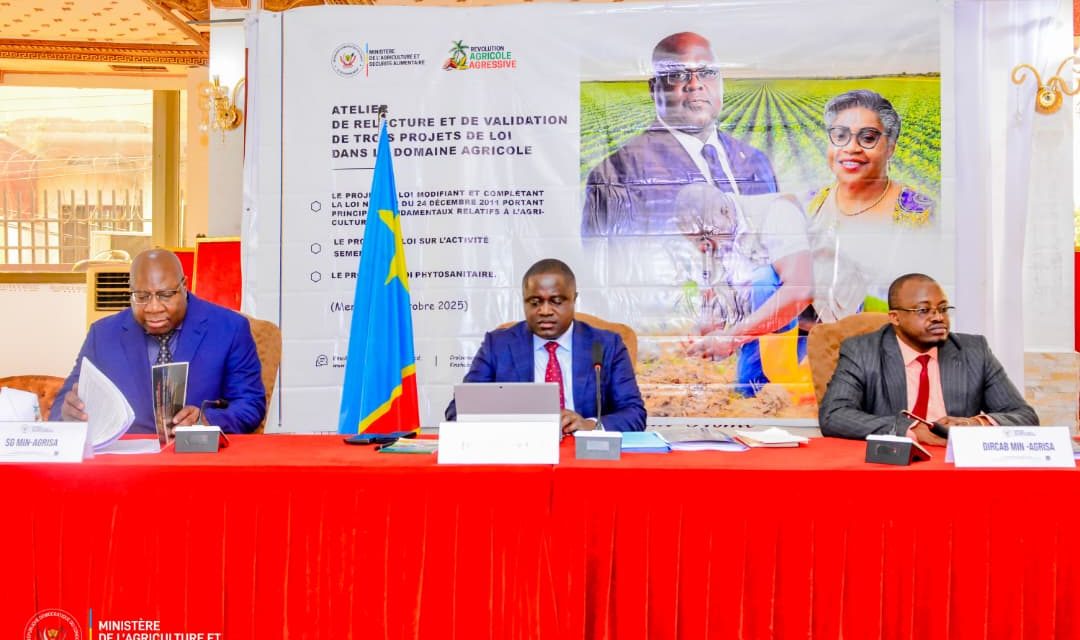
Faced with persistent obstacles related to the 2011 agricultural law, the Minister of State for Agriculture and Food Security, H.E. Muhindo Nzangi Butondo, has launched a strategic approach within this major portfolio: initiating a structural, inclusive, and resolutely forward-looking reform. Through a legislative review workshop, which he hosted this Wednesday, October 1, 2025, at the Béatrice Hotel in Kinshasa, the man his fellow citizens call a great patriot, is engaging scientists, institutions, and stakeholders around a single objective: to lift Congolese agriculture out of its stalemate and make it a lever for sovereignty, food security, and sustainable growth.
An Obsolete Law: The Starting Point for Change
Passed into law in 2011, the law on the fundamental principles of agriculture has not provided the expected impetus. Deemed inadequate, it is denounced as a brake on initiatives, particularly in terms of concrete implementation on the ground. The Minister of State acknowledges this impasse and emphasizes the urgency of finding a pragmatic compromise: "We cannot remain behind for 12 or 13 years," he insists.
Unlike past attempts, this reform is based on a logic of co-construction. By bringing together scientists, lawyers, provinces, partners, and several experts in the agricultural field, the Minister aims to build a solid, appropriate, enforced, and understood law. "Once compromised, we will be aggressive to ensure rapid progress," he affirmed, this man championing an aggressive agricultural revolution, adopting an approach that is both inclusive and proactive.
A Clear Vision: 5 Strategic Reform Priorities
The Minister structured his approach around five concrete pillars:
- 1. The structure of the law and its implementing provisions
- 2. Agricultural disaster management
- 3. Controlling foreign access to agricultural land
- 4. Creating a modern agricultural cadastre
- 5. Intensive and secure agricultural development
He also alluded to clarifying the agricultural tax regime
Each of these areas addresses a current structural issue, with the aim of strengthening governance, productivity, and the protection of national agricultural resources.
Agricultural Land Registry: Cornerstone of Land Sovereignty
The Minister of State's presentation places a more focused focus on the agricultural land registry. He describes it as a key tool for planning, land security, conflict management, and investment structuring. This lack of data, i.e., identification and mapping, prevents any coherent national strategy. "Where are the 80 million hectares? It's true they exist, but we don't see them," he asks.
Regulating Access to Land: To Protect Future Generations
The Minister of State openly denounces the laxity in land allocation, often sold off to private individuals or foreign interests. He calls for reserving strategic agricultural land for nationals, while imposing mandatory partnership models for all foreign investors. The aim is to preserve land sovereignty and prevent silent land confiscation.
Taxation, Seeds, Sovereignty: Towards a Comprehensive Agricultural Policy
Another strategic front: the agricultural tax regime, which is still unequal and poorly enforced. Muhindo Nzangi wants clear, operational, and equitable exemptions. He also advocates a reform of seed activities, strengthening INERA, SENASEM, and CAPSA to provide seeds accessible to all, especially small producers.
It's all in all. With this reform, Muhindo Nzangi is not just changing a piece of legislation; he is laying the foundations for a national agricultural revolution. By combining boldness, inclusion, pragmatism, and vision, it repositions the agricultural sector as a major strategic issue for sovereignty, employment, and development.
@MINETAT AgriSA Communications Unit