 EN
EN  FR
FR 

Context
As part of its policy to combat poverty in rural areas, empower women and young people through the promotion of agricultural and rural entrepreneurship, sensitive to nutrition and resilient to climate change in the provinces located around the city province of Kinshasa, the government of the Democratic Republic of Congo has concluded a financing agreement with the International Fund for Agricultural Development (IFAD), and other donors (French Development Agency and Global Environment Fund), with a view to implement the Empowerment Project through the Promotion of Agricultural and Rural Entrepreneurship, Sensitive to Nutrition, Inclusive and Resilient to Climate Change..
L’approche de développement territorial intégré repose sur une continuité géographique des interventions afin que les investissements dans les infrastructures (marchés territoriaux, pistes de desserte, embarcadères fluviaux) favorisent une logistique permettant l’écoulement des surplus agricoles produits grâce à des capacités de production agricole améliorées et intégrées (systèmes agroforestiers multi-strates, pratiques de gestion des terres et semences améliorées, mécanisation, petite hydraulique, vulgarisation), et par une valorisation de l’entreprenariat agricole et rural (activités post-récoltes, conservation, stockage, transformation et commercialisation), pour répondre aux besoins d’une demande alimentaire croissante et diversifiée des populations rurales et urbaines, notamment celle de Kinshasa. L’autonomisation par la valorisation de l’entreprenariat agricole et rural s’appuiera sur des opérateurs économiques organisés pour rentabiliser les aménagements et infrastructures réhabilitées. Les initiatives entrepreneuriales agricoles et rurales seront financées à coûts partagés en partenariat avec les institutions financières. Les plates-formes et réseaux nationaux (COPACO, CONAPAC, RENAFER), seront mobilisés pour pérenniser un entreprenariat agricole et rural plus propice et inclusif à l’agriculture familiale.
Project interventions will benefit approximately 450,000 rural households or more than 2.6 million people.At least 50% women and at least 50% young people will be targeted will be targeted
The base costs by component are as follows: component 1 “Family farming and agricultural and rural entrepreneurship” for USD 115.2 million (EUR 107.6 million) or 57% of the total base costs. Component 2 “Opening up and territorial markets” for 72.0 million USD (67.3 million EUR), or 35% of the base costs, and component 3 “Coordination and project management” for 15.7 million USD (14.7 million EUR), or 8%. The total costs per component including physical and financial contingencies are 116.5 million USD (108.9 million EUR) or 54% of the total costs, 80.7 million USD (75.5 million EUR) or 38% of the total costs and 16.3 million USD (15.2 million EUR) or 8% respectively for components 1, 2 and 3.
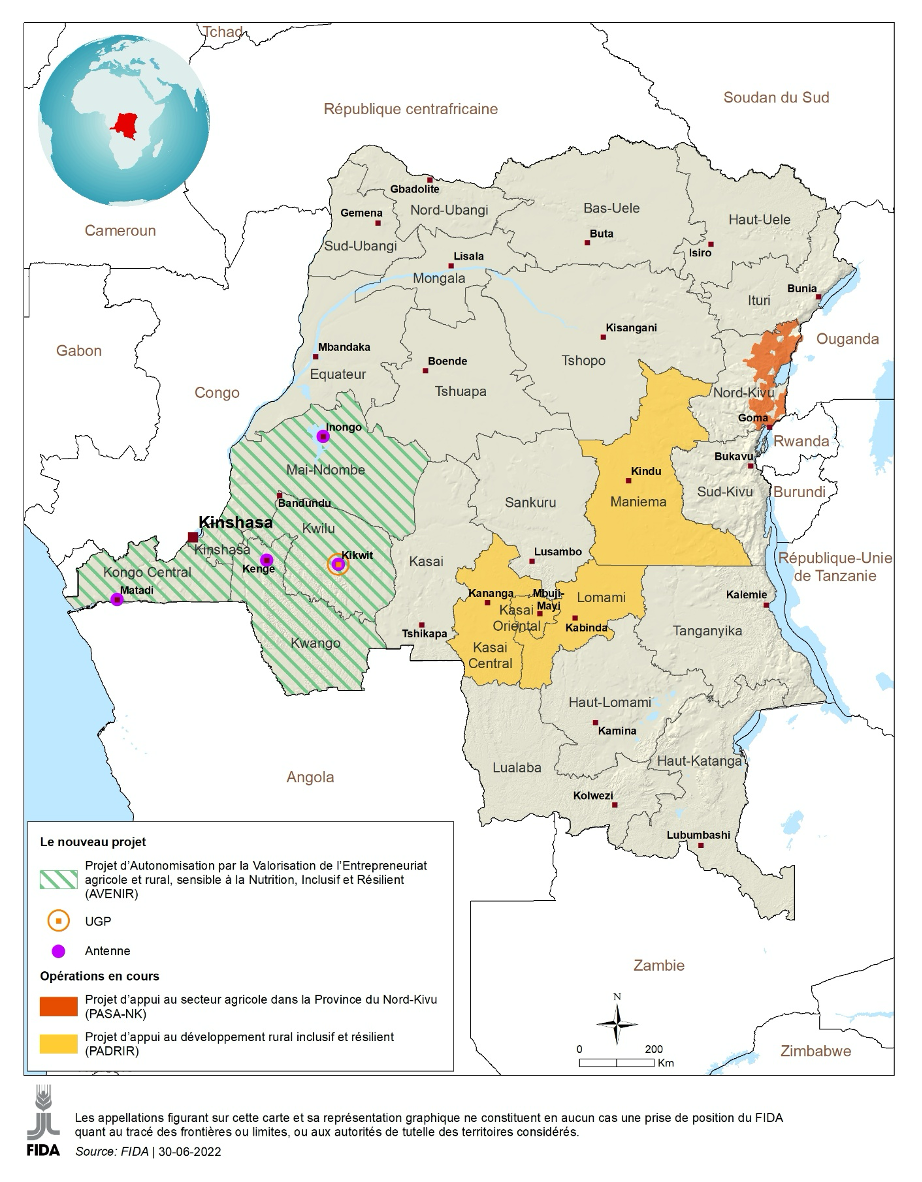
Intervention zones
(Kongo Central,
Kwango,
Kwilu
Mai-Ndombe
Results expected


- Project management
- Delegated project management
- Implementation partners
- Target groups
- Duration
- Source of funding
Ministry of Agriculture and Food Security (DRC)
Project Management Unit (PMU)
Several
Women, young people (aged 18 to 35), single mothers, populations living with disabilities (PVH) and Pygmy indigenous peoples (PAP) and rural households.
7 years, 2023 to 2030
| Source of funding | Financing plan (Cost) |
|---|---|
| FIDA (PBAS) | 40,8 M d’USD |
| FIDA (BRAM) | 4,5 M d’USD |
| AFD (financial loan) | 42,8 M d’USD |
| AFD (donation) | 10,7 M d’USD |
| Congolese Government | 19,0 M d’USD |
| Inst. Financial | 31,9 M d’USD |
| Beneficiaries | 6,9 M d’USD |
| GEF | 17,5 M d’USD |
| Financial deficit | 39,6 M d’USD |
| Total | 213,5 M d’USD |
La dynamisation du milieu rural permettra aux agriculteurs familiaux d’augmenter durablement leurs niveaux de productions et leurs capacités d’adaptation au changement climatique par la diversification agroécologique et d’adopter de meilleures pratiques nutritionnelles, et aux femmes et jeunes entrepreneurs agricoles et ruraux de bénéficier d’un écosystème porteur ainsi qu’un accès aux services financiers.
Family farms, OPs and SMEs better market their surplus agricultural production and processed products in markets directly linked to urban outlets (Kinshasa)
1.1 Development of agroecosystems
- Participatory territorial planning
- Support for land security and inclusive management of community forests and degraded lands
- Development of diversified agroforestry systems
- Sustainable fishing
- Support for the development of the sustainable coal sector (endogenous bamboo)
1.2. Sustainable crop planning and management
- Appui à l’amélioration de la production, de la disponibilité et de la qualité de matériel génétique (semence et alevins)
- Popularization in agri-livestock
- Development of small agricultural mechanization
1.3. Improving family nutritional security and supporting women’s empowerment
- Improvement of the diet (diversification and transformation of agricultural production)
- Nutritional education
- Functional literacy, gender and women's empowerment
- Access to drinking water, hygiene and sanitation.
1.4. Agricultural entrepreneurship and rural finance
- Management consulting systems for agricultural and rural businesses
- Improving the quality and sustainability of the financial services offering
- Shared cost financing of agricultural and rural businesses
The implementation of this component will contribute to the achievement of the second level of effect, namely “Family farms, POs and rural SMEs better market their surplus agro-sylvo-pastoral products and their processed products on territorial markets at remunerative prices” through:
2.1 Réhabilitation des infrastructures économiques
- Rehabilitation of Physical Markets
- Rural roads to open up agricultural production areas and access to markets
- River ports
2.2. Management and maintenance system for economic infrastructures
- Establishment and support of interprofessional market consultation frameworks
- Implementation/Support and support of rural road maintenance systems.
- Support for producer organizations on the markets
Placed under the administrative supervision of the Ministry of Agriculture and Food Security, the Project is under the supervision of a National Steering Committee (COPIL) comprising all the technical ministries concerned: Agriculture, Rural Development, Fisheries and Livestock, Finance, Environment and Sustainable Development, Gender and Family, Small and Medium Enterprises, etc.
Delegated project management is ensured by the Project Management Unit (PMU): (with its headquarters in Kikwit, four provincial offices in Mbanza Ngungu, Kenge, Kikwit and Inongo) and reports to the Ministry of State of Agriculture and Food Security, whose Secretary General, Mr. José ILANGA LOFONGA chairs the Project Steering Committee.